

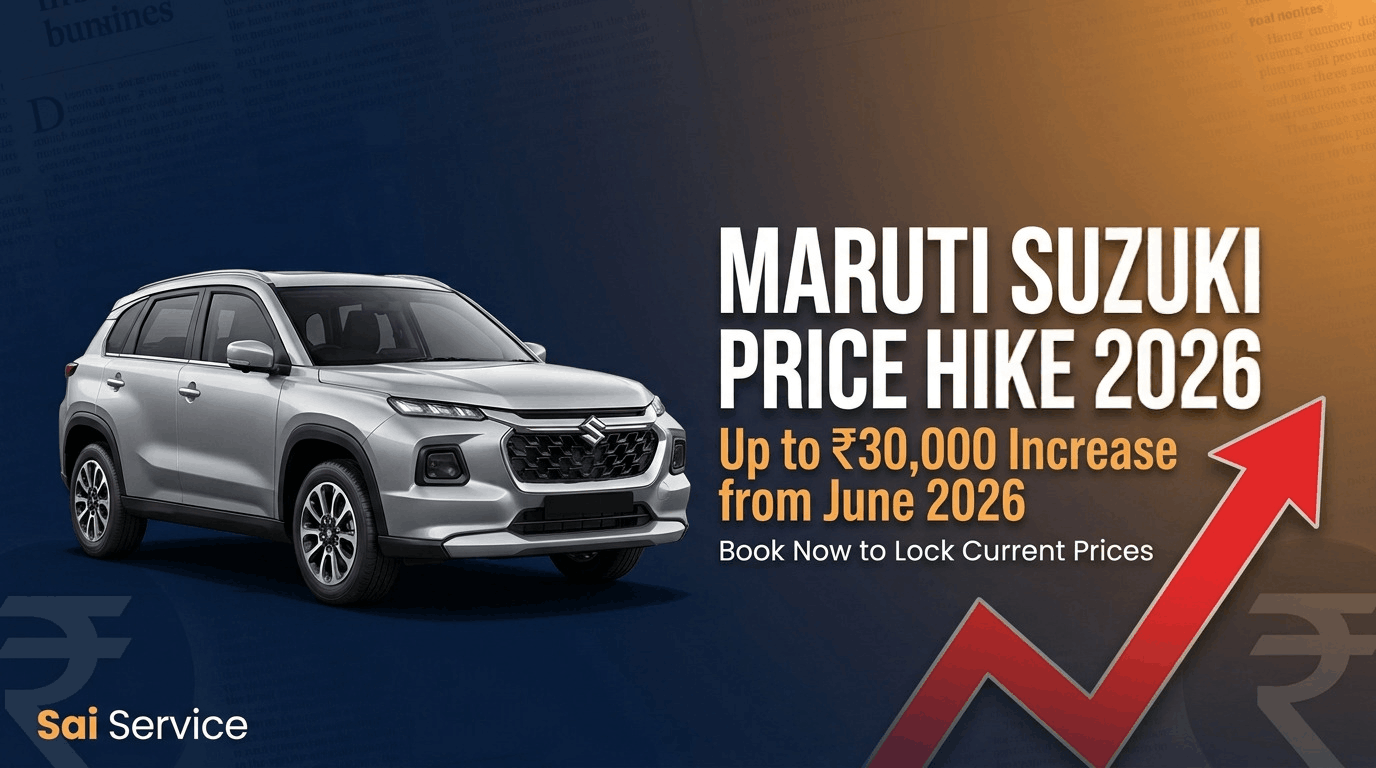
Quick Answer : Maruti Suzuki has announced a price hike of up to ₹30,000 across its model range effective from 1st August 2026 and further calibrated increases through the second half of 2026 are widely expected as new emission norms, input cost inflation and BS6 Phase 2 compliance continue to push costs upward. Buyers planning a purchase should book early to lock current on-road prices. Six proven ways to save despite the hike: (1) book before the next hike wave, (2) maximise exchange bonus on your old car via Sai Service True Value, (3) use Maruti Suzuki Smart Finance for the best EMI schemes, (4) opt for CNG variants to offset higher fuel spend, (5) claim corporate and loyalty discounts and (6) bundle insurance and accessories at booking. Sai Service serves Mumbai, Pune, Kolhapur, Goa, Hyderabad and Kerala with transparent on-road pricing and doorstep test drives.
Maruti Suzuki India, the country's largest car maker, has announced a price hike across its entire vehicle range effective - 1st August 2026. The increase applies to popular models including the Alto K10, S-Presso, WagonR, Celerio, Swift, Dzire, Brezza, Ertiga, Eeco, Fronx, Baleno, Grand Vitara, Jimny, XL6, Ciaz, Invicto, Victoris and the new eVitara EV. Further calibrated increases through the second half of 2026 remain widely expected.
If you have been planning to buy a new Maruti Suzuki car, understanding this price hike matters. This complete guide covers exactly how much prices will increase, why the hike is happening, when the next wave could arrive and six proven strategies to save money despite the price movement. Everything a Maruti buyer in India needs to know before booking their next car in 2026.
The 1 August 2026 Maruti Suzuki price hike ranges up to ₹30,000 depending on model and variant. Entry-level hatchbacks will see the smallest absolute increases (roughly ₹10,000 to ₹15,000) while premium Nexa SUVs at the top of the range will absorb the highest hikes (up to ₹30,000).
The percentage impact is small in relative terms (typically 0.5 percent to 1.5 percent of ex-showroom price) but the impact on on-road pricing is often larger once GST, road tax, insurance and RTO fees are recalculated on the higher ex-showroom base.
|
Model |
Previous Ex-Showroom (approx) |
Expected Hike Range |
New Ex-Showroom (approx) |
|
₹3.99 to ₹6.15 lakh |
₹8,000 to ₹15,000 |
₹4.00 to ₹6.15 lakh |
|
|
₹4.26 to ₹6.10 lakh |
₹8,000 to ₹15,000 |
₹4.34 to ₹6.25 lakh |
|
|
₹5.65 to ₹7.65 lakh |
₹10,000 to ₹18,000 |
₹5.75 to ₹7.83 lakh |
|
|
₹5.25 to ₹7.25 lakh |
₹10,000 to ₹18,000 |
₹5.35 to ₹7.43 lakh |
|
|
₹6.49 to ₹9.65 lakh |
₹12,000 to ₹22,000 |
₹6.61 to ₹9.87 lakh |
|
|
₹6.79 to ₹10.15 lakh |
₹12,000 to ₹22,000 |
₹6.91 to ₹10.37 lakh |
|
|
₹6.10 to ₹8.10 lakh |
₹10,000 to ₹18,000 |
₹6.20 to ₹8.28 lakh |
|
|
₹7.55 to ₹13.15 lakh |
₹15,000 to ₹25,000 |
₹7.70 to ₹13.40 lakh |
|
|
₹6.66 to ₹10.28 lakh |
₹15,000 to ₹22,000 |
₹6.81 to ₹10.50 lakh |
|
|
₹8.26 to ₹13.01 lakh |
₹18,000 to ₹28,000 |
₹8.44 to ₹13.29 lakh |
|
|
₹8.80 to ₹13.50 lakh |
₹15,000 to ₹25,000 |
₹8.95 to ₹13.75 lakh |
|
|
₹12.00 to ₹15.00 lakh |
₹20,000 to ₹28,000 |
₹12.20 to ₹15.28 lakh |
|
|
₹10.99 to ₹19.99 lakh |
₹22,000 to ₹30,000 |
₹11.21 to ₹20.29 lakh |
|
|
₹10.50 to ₹19.99 lakh |
₹22,000 to ₹30,000 |
₹10.72 to ₹20.29 lakh |
|
|
₹12.31 to ₹15.05 lakh |
₹20,000 to ₹28,000 |
₹12.51 to ₹15.33 lakh |
|
|
₹9.50 to ₹12.29 lakh |
₹18,000 to ₹25,000 |
₹9.68 to ₹12.54 lakh |
|
|
₹24.97 to ₹29.16 lakh |
₹25,000 to ₹30,000 |
₹25.22 to ₹29.46 lakh |
|
|
₹15.99 to ₹20.01 lakh |
₹15,000 to ₹25,000 |
₹16.14 to ₹20.26 lakh |
|
|
₹5.20 to ₹7.05 lakh |
₹8,000 to ₹15,000 |
₹5.28 to ₹7.20 lakh |
Note : Exact hike per variant may vary slightly by state and by dealer implementation. Final on-road price includes GST, road tax, insurance and RTO charges over and above ex-showroom.
Multiple structural pressures are driving this hike. The reasons matter because they signal whether more hikes are coming and how much of the current pricing will hold through 2026.
Steel, aluminium, copper, plastic resins and semiconductor prices have remained elevated through 2025 and into 2026. Raw material inflation is the single largest reason for automotive price increases in India across all manufacturers.
Ongoing BS6 Phase 2 compliance and new Real Driving Emission (RDE) requirements have added technology cost to every internal combustion engine variant. Hybrid and EV models absorb even higher battery and electronics component costs.
The mandatory addition of six airbags as standard, ESP, hill-hold assist and other active safety features has added cost. Bharat NCAP crash test compliance is another meaningful cost input in 2026.
Semiconductors, hybrid battery cells and specific electronic control units are imported. Currency movement and global supply chain costs continue to feed into Indian ex-showroom pricing.
Rising fuel costs affect inbound logistics to Maruti's Manesar and Gujarat plants and outbound distribution to dealerships. Dealer margins have also been rebalanced modestly.
Historical trend suggests yes. Maruti Suzuki has typically implemented two calibrated price hikes per year. The 1 August 2026 hike is the main announced adjustment for the second half of the year. A further calibrated hike in the October to December 2026 window remains possible, especially if input cost pressures continue and new safety norms come into force.
|
Year |
Hike Waves |
Cumulative Increase |
|
2024 |
2 waves (Jan and Aug) |
Approx 1.7 to 4.5 percent depending on model |
|
2025 |
2 waves (Jan and July) |
Approx 2 to 4 percent depending on model |
|
2026 (1 August upcoming) |
1 wave announced, more possible |
To be confirmed post 1 August |
The pattern is consistent enough that waiting past 1 August 2026 is unlikely to yield lower prices. If anything, buyers who wait past 1 August will face immediate hike cost plus the risk of a further adjustment later in the year.
Yes, generally. When Maruti Suzuki raises prices, most other Indian passenger car makers follow within 30 to 60 days. Tata Motors, Hyundai India, Kia, Mahindra and Honda have all traditionally announced their own price hikes shortly after Maruti's announcements, driven by the same underlying cost pressures.
For buyers, this means switching to a different brand to escape the hike is not a viable strategy. The industry moves together. What matters is choosing the right time to lock a booking price with the right dealer.
Even with the price increase, smart buyers can save meaningful money by combining several strategies. Here are the six most effective ways.
The single biggest saving comes from locking the current on-road price before the next hike. Even a ₹15,000 to ₹30,000 difference matters over the life of the ownership. Maruti Suzuki dealers typically honour the on-road price at the time of booking as long as delivery happens within the specified window.
If you own an existing car (any brand), a Maruti Suzuki True Value exchange evaluation can add ₹15,000 to ₹75,000 in exchange bonus over the fair market price on your old car. Bring your car in for evaluation before booking your new Maruti. Sai Service handles True Value exchange valuations across all our branches with on-the-spot valuations in 30 minutes.
Maruti Suzuki Smart Finance is Maruti's captive lending partnership with multiple banks and NBFCs. Interest rates are typically 0.25 percent to 0.75 percent lower than what walk-in bank rates offer and the approval process is faster because Sai Service handles documentation end to end. Sai Service also runs periodic zero-processing-fee finance schemes with partner banks.
The price hike affects ex-showroom cost. Ongoing fuel cost affects your monthly ownership economics. Choosing a Maruti Suzuki CNG variant (available on Alto K10, WagonR, Swift, Dzire, Ertiga, XL6, Brezza, Fronx, Grand Vitara and Victoris) can save ₹3,500 to ₹5,000 per month in fuel. Over a five year ownership, that saving typically exceeds ₹2 lakh, easily absorbing the price hike and much more.
Maruti Suzuki offers corporate discounts for employees of hundreds of empanelled companies (Infosys, TCS, Wipro, Reliance, government departments and many more). Existing Maruti owners also qualify for loyalty discounts. Ask Sai Service specifically about all applicable discounts before finalising your on-road price.
Insurance premiums and accessory pricing are often more negotiable at booking than after delivery. Sai Service offers insurance renewal and first-year insurance at competitive rates. Genuine Maruti accessories (mats, mudflaps, seat covers, ceramic coating, extended warranty) are best negotiated in a booking bundle.
Practical guidance for buyers considering a Maruti Suzuki purchase in the second half of 2026:
‣ If you can book before 1 August 2026 : lock the current pre-hike on-road price now. Every day past 1 August carries real hike cost.
‣ If you have an existing car to exchange : get the True Value evaluation done first. That number changes your effective budget.
‣ If you are eyeing a Nexa premium model (Grand Vitara, Victoris, Baleno, Fronx, Jimny, XL6, Ciaz, Invicto, eVitara) : the higher price band means larger absolute hikes ahead. Booking now saves the most.
‣ If you are interested in the new Maruti Brezza Facelift launching July 23, 2026 : register your interest at Sai Service now to be first in the delivery queue at launch pricing.
‣ If you are looking at the eVitara EV : BaaS (Battery as a Service) financing keeps upfront cost at ₹10.99 lakh even after the hike. Ask Sai Service Nexa about BaaS enrollment.
‣ If a used Maruti fits your budget better : Maruti Suzuki True Value at any Sai Service outlet gives you a certified pre-owned car with a 1 year warranty at a fraction of new-car pricing.
Sai Service is an authorised Maruti Suzuki dealer in India since 1985, serving buyers across Mumbai, Pune, Kolhapur, Goa, Hyderabad and Kerala through Arena and Nexa showrooms, authorised Service Centres, True Value pre-owned outlets and Commercial Vehicle branches. Every Sai Service branch offers:
• Transparent on-road pricing with no hidden delivery charges
• Doorstep test drives across all major cities and surrounding areas
• End-to-end finance and insurance handling
• Maruti Suzuki Smart Finance access with the best EMI schemes
• True Value exchange evaluations completed on-the-spot
• Fast delivery timelines on most popular Maruti models
To lock current pricing before the next hike wave, book your test drive online or locate your nearest Sai Service branch today. Every day you wait past a price hike wave is real money left on the table.
A. Yes, Maruti Suzuki has announced a price hike of up to ₹30,000 across its model range effective 1 August 2026, affecting popular models including the Alto K10, S-Presso, WagonR, Celerio, Swift, Dzire, Brezza, Ertiga, Baleno, Fronx, Grand Vitara, Victoris, XL6, Jimny, Invicto, Ciaz, eVitara and Eeco. Further calibrated hikes remain possible later in 2026 as input cost pressures continue.
A. The 1 August 2026 Maruti Suzuki price hike ranges from approximately ₹8,000 for entry-level models like the Alto K10 up to ₹30,000 for premium Nexa SUVs like the Grand Vitara, Victoris and Invicto. In percentage terms the hike is approximately 0.5 percent to 1.5 percent of ex-showroom price, though on-road impact is larger due to GST, road tax and insurance being recalculated on the higher base.
A. Multiple structural factors drove the 2026 Maruti Suzuki price hike. Rising input costs on steel, aluminium, copper and semiconductors are the largest factor. Ongoing BS6 Phase 2 emission compliance costs, mandatory safety upgrades (six airbags standard, ESP, hill-hold), currency movement on imported components and rising logistics costs also contributed. These are structural pressures affecting the entire Indian automotive industry, not just Maruti Suzuki.
A. Based on Maruti Suzuki's historical price hike pattern (typically two calibrated hikes per year), a further calibrated adjustment in the October to December 2026 window remains possible following the 1 August 2026 hike. Buyers planning a purchase should reasonably expect this and book before 1 August 2026 to lock current pre-hike on-road pricing.
A. Yes, generally other Indian passenger car manufacturers including Tata Motors, Hyundai India, Kia, Mahindra and Honda follow Maruti Suzuki price hikes within 30 to 60 days. This is because the underlying cost pressures (raw materials, emissions compliance, safety upgrades) affect all manufacturers similarly. Switching brands to escape a Maruti hike is not a viable strategy.
A. Six proven strategies help buyers save money despite the Maruti price hike. First, book before the next hike wave to lock the current on-road price. Second, maximise your exchange bonus via Maruti Suzuki True Value evaluation on your old car. Third, use Maruti Suzuki Smart Finance for the best EMI schemes with lower rates. Fourth, choose CNG variants to save ₹3,500 to ₹5,000 per month in fuel. Fifth, claim corporate and loyalty discounts. Sixth, bundle insurance and accessories at booking.
A. Historical trend suggests Maruti Suzuki prices do not decline once hiked. The pattern over the last several years shows only upward movement. Waiting past a hike wave rarely yields lower prices. If you are ready to buy within 60 to 90 days, booking now to lock current on-road pricing is typically the more cost-effective decision. If you cannot buy for six months or more, factor in another likely hike wave when budgeting.
A. You can book any Maruti Suzuki model at current on-road prices at authorised dealers before the next hike wave. Sai Service is an authorised Maruti Suzuki Car dealer since 1985 with Maruti Suzuki Arena, Maruti Suzuki Nexa, True Value and Service branches across Mumbai, Pune, Kolhapur, Goa, Hyderabad and Kerala. Sai Service handles booking, exchange evaluation, finance and insurance end to end, with doorstep test drives available across all major cities. Book online via the Sai Service website or call your nearest branch directly.